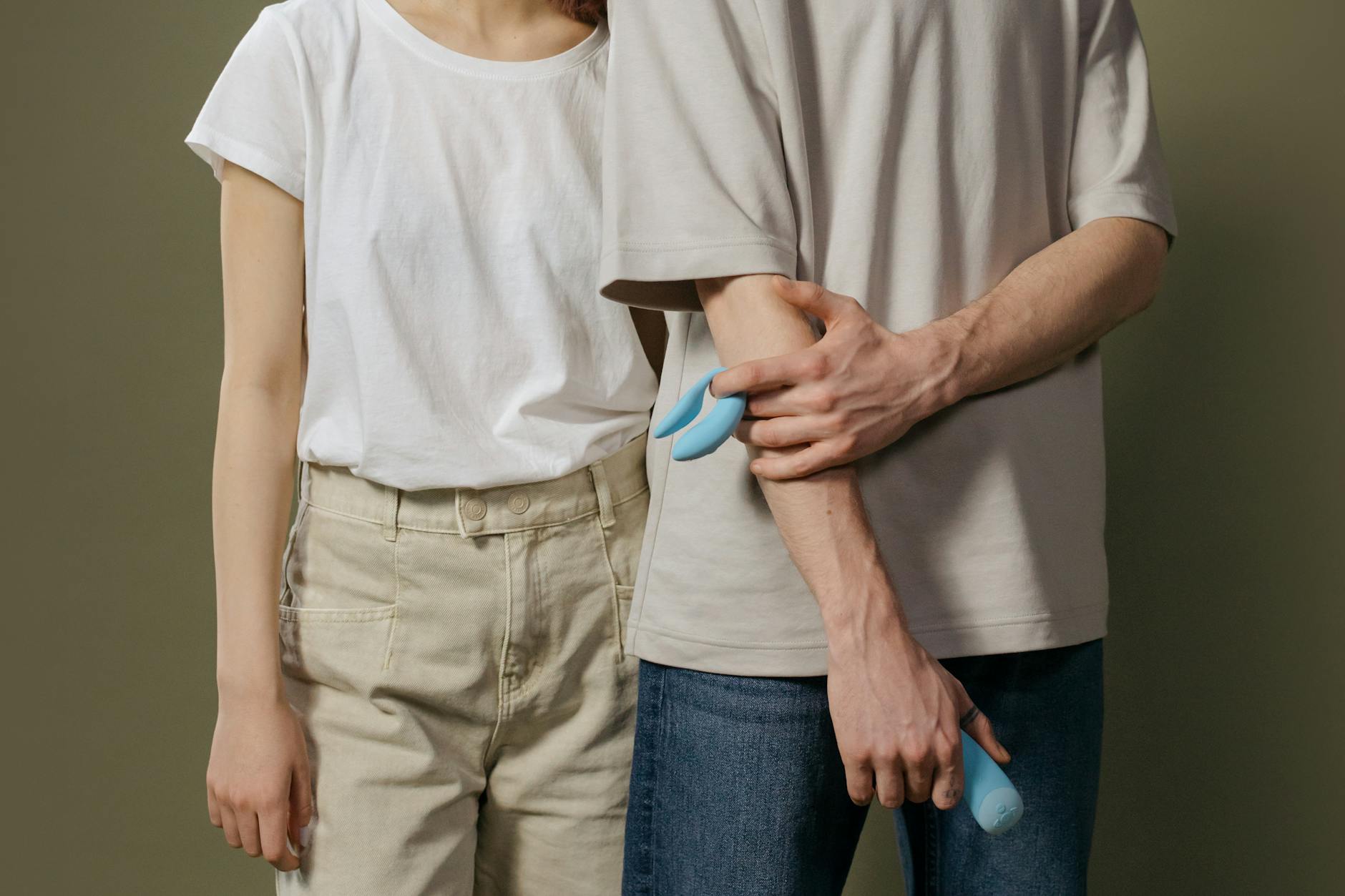
Let's start with the thing nobody talks about
Introducing a toy into partnered sex isn't really about the toy. It's about what the toy represents, and whether both people feel safe enough to talk about it without shame, defensiveness, or fear. Get that part wrong, and even the best lemon clitoral vibrator becomes a source of tension.
Get it right, and you unlock something most long-term couples never access: the ability to talk explicitly about pleasure without flinching.
Why the conversation matters more than the device
Here's what I see in my practice constantly. One partner wants to introduce a lemon vibrator (or any toy). The other partner hears it as: "You're not enough for me." Or: "You've been doing it wrong." Or: "I'm not attracted to you anymore."
None of those things are true. But that's what the silence creates. So before you buy anything, before you even pull up Hello Nancy's collection of lemon sexual toys, sit down and say this out loud: "I want to explore something new together, and I think it could feel really good for both of us."
That's it. Notice what you're not saying. You're not saying your partner has failed you. You're not making it conditional on their performance. You're offering collaboration.
The best partnerships I've worked with treat sex like a team sport, not a performance review. A toy is a tool, like a new position or a longer warm-up time. It's not a critique.
How to bring it up without creating defensiveness
Timing matters. Don't have this conversation during sex, right after sex, or during an argument. Pick a calm evening when you're both present and have privacy.
Start with curiosity, not instruction. "I've been thinking about trying something. Have you ever considered using a toy together?" is infinitely better than "I want you to use this on me." The second one positions the toy as something you need them to do. The first positions it as an experiment you're inviting them into.
Answer questions without getting defensive. If your partner asks "Why do you want this?" don't hear accusation. Hear genuine wondering. "I think it might feel different for both of us" or "I read that clitoral vibrators can help with orgasm, and I'm curious" are honest, simple answers.
If your partner says no, that's also valid. Respect it, and don't bring it up again for at least a few months. Sometimes people need time to sit with the idea. Sometimes they genuinely don't want it, and that's their boundary.
Choosing the right lemon vibrator for partnered play
Not all lemon vibrators are created equal for partnered sex. Some designs work better when someone else is using them on you. Others work better for self-stimulation during partnered sex.
If your partner will be controlling the device, pick something intuitive. A simple three-button interface or a smooth, easy grip makes all the difference. You don't want them fussing with controls while you're trying to stay present. Lemon clitoral vibrators like the Lem are specifically designed for partnered use because the ergonomics support that.
If you want to use it on yourself while your partner is inside you or beside you, anything from the Hello Nancy collection works. Just test the patterns beforehand so you know what feels good and you're not surprised mid-sex.
Start with the lowest intensity setting. Seriously. Even if you normally use intensity level 5, start at 1 or 2 when your partner is controlling it. Sensation feels different when someone else is directing it, and you want to be pleasantly surprised, not overwhelmed.
The actual integration: five ways to start
Option 1: Foreplay only. Use the lemon vibrator during foreplay to build arousal, then set it aside before penetration. This is the lowest-barrier entry. It takes zero integration and feels like a natural addition to what you're already doing.
Option 2: External stimulation during penetration. If you're a woman or person with a vulva, using a clitoral vibrator during penetrative sex can be deeply satisfying because it targets the clitoris while your partner stimulates you internally. You control the toy, your partner controls their pace. It's collaboration.
Option 3: The observer model. One partner uses the toy on themselves while the other watches and participates otherwise (kissing, touching, verbal encouragement). This removes the pressure of mutual mechanics and lets you both focus on what feels good.
Option 4: Mutual stimulation. You use the vibrator on your partner while they touch you. Everyone gets attention simultaneously.
Option 5: Just having it in the room. Sometimes knowing a lemon vibrator is available changes the energy of sex. You might not use it every time, but the option creates a sense of play and permission.
None of these is "the right way." Pick what fits your body, your partner, and your dynamic.
The logistics nobody mentions
Water-based lubricant is your friend. Even if you don't usually need it, adding some when using a toy can change the sensation in really nice ways. Plus it reduces friction if your partner is holding the device for an extended period.
Battery life matters more than you'd think. A toy dying mid-session is awkward and jarring. Check the charge before you start.
Clean the toy after use. It takes ninety seconds with warm soapy water. Skipping this step is how toys become uncomfortable to use and resentment quietly builds. (I'm not speaking from personal experience, but from years of couples telling me they stopped using toys because "hygiene became an issue.")
Have a non-verbal signal if something shifts and you need to stop or change direction. "Green light, yellow light, red light" is corny but it works. You don't always have words when you're in the middle of something, so agree beforehand.
What if your partner is skeptical
Some people come around slowly. They might think toys are weird, or unfaithful, or unnecessary. That's a belief, not a fact. You can't argue someone out of a belief with logic.
What you can do is demonstrate that toys don't replace intimacy. They expand it. Offer to watch educational content together. The Hello Nancy blog has pieces on how to use lemon clitoral vibrators for beginners that are explicit and destigmatizing. Sometimes seeing it framed in a sex-positive, non-threatening way shifts perspective.
You can also ask what specifically feels uncomfortable. "I'm worried it means you're not satisfied with me" is totally different from "It seems weird." The first one needs reassurance. The second one needs exposure.
If your partner remains firmly against it, you have a choice: accept that boundary, or recognize it as a symptom of a larger mismatch in how you approach pleasure. Both are valid conclusions. Neither one makes either of you bad.
After the first time
Debrief. Not in a clinical way. Just "That was fun" or "I liked when you..." or "Next time, try..." Feedback makes the next attempt better. It also signals that pleasure is something you're both actively invested in, not something that should just happen magically.
Try it more than once before you decide if you like it. First attempts are awkward because there's novelty and uncertainty. By the third or fourth time, you'll have figured out what actually works for your bodies and your dynamic.
Expect that what works this month might not work next month. That's normal. Sometimes a lemon vibrator is exactly what you need. Sometimes you'd rather connect without it. Both are fine.
Consider checking in about pleasure more broadly. "What's one thing you'd like to try?" "Is there anything we've stopped doing that you miss?" "What would feel good this week?" These conversations keep sex from becoming routine and they keep both partners feeling valued.
FAQs
How do I know which Hello Nancy lemon vibrator to start with?
Start with something mid-range in price and versatility. The Lem vibrator is designed specifically for partnered use because of its ergonomics and intuitive controls. It's a confidence-builder for someone new to using toys with a partner because it just works. If you want something smaller, the Berri is effective and less intimidating visually.
What if my partner gets jealous when I use a toy during solo sex?
Jealousy is often really about feeling excluded or suddenly competing with something. Have a conversation: "This isn't about replacing you. This is about exploring my own body and my own pleasure. You're welcome to be part of it, or we can keep that separate." Some couples integrate toys into partnered sex and keep solo toy use totally separate. Both approaches are fine as long as you've agreed on it.
Can we use the same toy during partnered sex and solo sex?
Yes, as long as you clean it between uses. A toy isn't "used up" or "changed" by having different hands on it. It's just a tool.
How often should we be using a lemon clitoral vibrator together?
There's no frequency requirement. Use it as often as it feels good and not more. Some couples use toys weekly. Some use them once a month. Some introduce them during a particular season of their relationship. There's no rulebook here.
My partner wants to use it, but I'm nervous about sensation.
Talk through it. Start at the lowest setting. Use it for thirty seconds, then pause. Check in: "How does that feel?" You can build from there. Pleasure isn't a race. Taking your time actually deepens the experience.
What if we try it and it's awkward or uncomfortable?
That's data. "That wasn't working for me" is useful information. Don't shame each other for it. Try a different approach. Maybe your partner controls it instead of you. Maybe you use it solo while your partner does something else. Maybe you return to it in six months when you're both more relaxed. Awkwardness is just the price of learning something new together.
The real point
Using a lemon vibrator with a partner isn't about the device. It's about building a relationship where pleasure is something you talk about, iterate on, and prioritize together. That skill transfers everywhere. If you can ask for what you want sexually, you can ask for what you want in conversations, in work, in how you spend your time.
Start the conversation. Be curious. Listen. Trust that if it's going to work, it will. And if it doesn't, that's information too.